

Identifying and Leveraging AI & ML opportunities
a prioritized portfolio approach
In a previous article, I discussed how future organizations are prioritizing AI/ML use-cases and the different ways to evaluate all the dimensions that these initiatives entail. These companies are gaining early traction and learning from their experiences with low-risk and high-impact projects, and the potential of success has been greatly increased.
Looking at a leading New Zealand technology exporter and powerhouse that is Gallagher Group
When it comes to innovation and staying ahead of the curve, whether that’s with high levels of R&D spending or the data-driven company culture, Gallagher Group is an exemplar of a high-performing tech company. It made perfect sense to them that AI & ML are the next step for data-driven decisions and analytical insights that can drive their business intelligence into the future.
Following a Prioritization Framework: The Five Steps
1. Define
The idea is like a sales funnel, where any potential idea or example of AI/ML being used within a similar business department or unit is gathered with its definition and answering a key question: is this a machine learning problem?
2. Validate
To validate the use-case, it must be determined if the Ease of Implementation makes this potential project worth the consideration; while looking at Data/Infrastructure, Algorithm/Solution, Processors/Systems, and Know-How.
- Also, at this stage an initial risk assessment should be done to determine how many elements of risk are there in the model and if a Trustworthy Assessment needs to be completed, which should be with an expert on the risk factors relevant to the business.
- If the Ease of Implementation is very low and the risk is high, consider refining the use-case.
3. Analyze
This involves a business impact assessment which will determine direct benefit as a monetary value and should be how much savings or profit per month. Also consider the indirect benefit, which together with direct benefit equals the potential absolute value of the project.
- Also, some initiatives will require an ROI assessment done, which involves calculating the cost of implementation in labour costs and compute time/resources.
4. Evaluate
Once all these factors are known, they can be mapped onto a 4-quadrant matrix. This will clearly show which projects have the potential to deliver large monetary returns for low effort and low risk. These projects should be classified as ‘Quick Wins’. There is also Big Bets (High Business Impact, Low Ease of Implementation) and Incremental (Low Business Impact, High Ease of Implementation).
5. Prioritize
The last step involves the right stakeholders deciding on which projects to pursue and remember, this framework works better as a communication tool and not as a decision tool. It should empower the team to say NO to good projects and YES to great ones.
An example: AI/ML use-cases
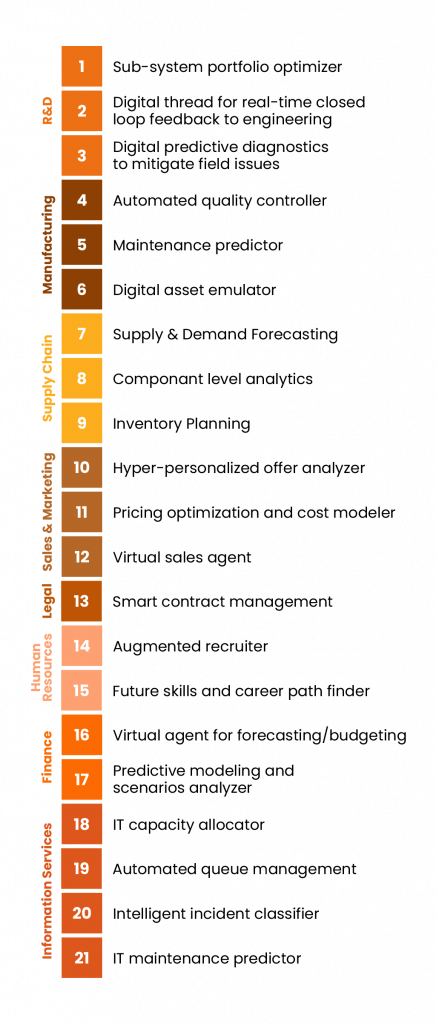
The Result:
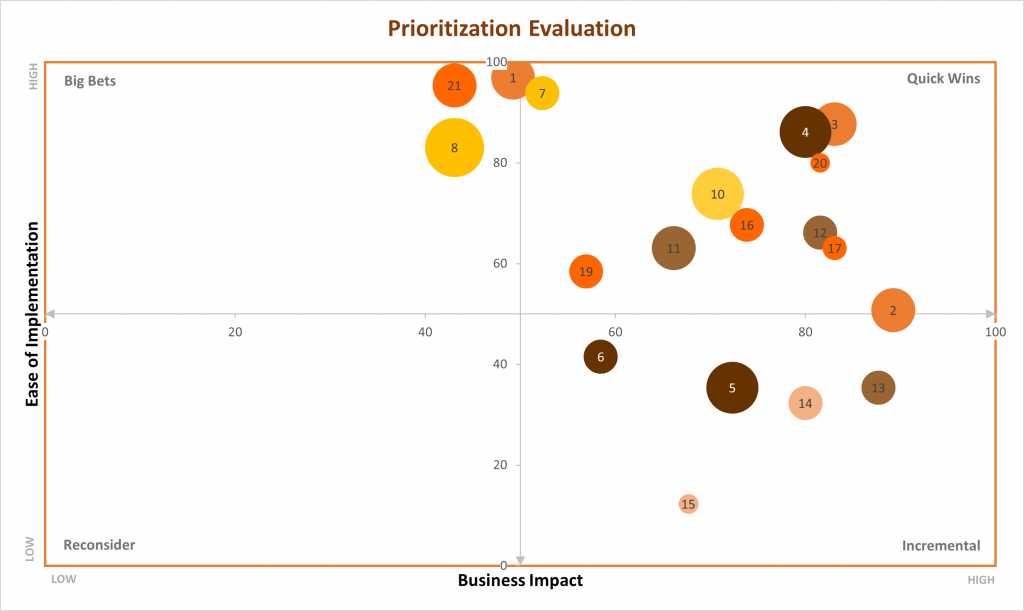
Staying Focused:
From this you can see that 1, 7 & 21 are Big Bets, 4, 10 & 12 are Quick Wins and 5, 13 & 14 are incremental. The objective is then to manage these projects accordingly and from this, you have a prioritized portfolio approach.
Conclusion:
In order to properly benefit from emerging technologies, future-focused companies are doing more than just choosing projects out of thin air. They’re specifically evaluating and prioritizing them with strategic company objectives. If you are interested in the research I did at the Gallagher group, please follow this link for a copy of my research poster presented to the University of Waikato.

An AI-Driven Organization: Use Case Prioritization for Successful AI Deployment
Artificial intelligence and machine learning are transforming business. It can make guided decisions in every field, from harvesting crops to bank loans. AI technologies are growing; there are many development platforms, processing power and storage data options. These advanced services are becoming more economical with time. If this service automation continues, AI will add thirteen trillion dollars to the economy in the next decade.
Why does AI Deployment Still Come With High Failure Rates?
Despite the advancements, the right AI deployment is still a challenging issue. Many companies are failing. This survey asked thousands of executives about using and organizing AI-driven analytics. It was surprising that 92% of the firms do not adopt practices required for widespread AI adoption. Many firms are just using AI in a single business process. The significant failure rate indicates to rewire deployment practices. Many AI initiatives come with intimidating organizational and cultural barriers. The first step is to break down the tasks into achievable goals to get the best out of AI opportunities.
AI-Powered Business: The Future Of Organizations
Many business owners take AI as a plug and play technology, expecting overnight results. To keep some projects running perfectly, they spend millions in AI software tools, model development, data infrastructure and data expertise. However, often a long time will pass by without significant expected wins. Owners usually consider narrow AI requirements. The limited mindset brings issues in wider AI adoption. To avoid such mistakes and get successful AI adoption, they have to follow the mentioned directions.
1. Understand AI
The foremost thing to get familiar with is the concept of AI. AI models can be deployed in various ways through seeing the organizational needs and the expected business intelligence from the organization’s data. Enterprises mine social data to bring improvement in customer relationship management. It can result in the optimizing of logistics, improved governance and tracking of assets. Machine learning is playing a vital role in the adoption of AI. ML makes extracting business intelligence a lot easier and reliable.
2. Identify The Problems AI Can Solve
Once the basics are apparent, the next step calls for exploring business ideas. Consider adding new capabilities and value to the intended business services. This stage ends with specific use cases or the business problems that the organization needs to address with AI adoption. Natural language processing, recommendation systems, image processing and other such strategies will help build intelligence in the system.
3. Understand The Internal Capability Gap
There comes a tradeoff between what the organization expects and the real solution. The business should know of its capabilities and limitations. The internal Capability Gap fills by knowing what the organization hopes to acquire and what to do internally before moving to an AI solution.
4. Contact The Experts And Start With Small Steps First
Once the business gets ready from a technology and organizational standpoint, the next step is building and integrating. Analyze the project and make small milestones. Take small steps at the start. AI experts and consultants prove helpful in this regard. Form a small team to complete the first milestone in the stipulated timeframe. After completing the first milestone, the organization can decide on the future roadmap. It prepares an elaborated long term strategic plan. The final integration step requires both the business and the AI experts to make the plan successful.
5. Integrate Data
After agreeing on which AI pilot, the next step is to pre-process the data to get consistent and high-quality data. There are several data preprocessing techniques that help in utilizing the data. This action gives rich and accurate data ready with all the necessary AI dimensions. The better the data, the better the model results.
6. Start Small
Try to apply AI on a sample of the data, don’t take all the data in one go. Collect model feedback, value the progress and then proceed accordingly. If the model proves value, go for incremental development. It increases the chances of success and the organization catches the problems at the start.
Use Case Prioritization
Once the organization decides to go for AI-powered business, the next step comes to prioritize the use cases. The prioritization assesses the various AI implementations available and the financial value. The decision might appear challenging but match the initiatives directly to the business value. Look over the feasibility and potential dimensions and note them in a 2 x 2 matrix. It will help you see the near term visibility and look at the company’s financial value associated with each dimension. It asks for recognition and ownership from top-level executives.
Get Enough Relevant Business Knowledge
Business Knowledge refers to understanding the business needs and the problems AI models expect to solve. Identify the higher level associated with every need and problem solution. Sometimes, business leaders go for more extensive research to get valuable and tractable use cases. AI experts also guide further in the exploration phase to develop real solutions.
List Top Business Problems
The business leaders and the management lists out the problems where they think AI will prove beneficial. The issues get listed after conducting extensive workshops and discussions. Write the use cases in a specific format by mentioning the required details. The organization then proceeds to the prioritization step. The following questions will help you in prioritizing use cases:
- Problem – How the problem can be solved using AI or ML models?
- Impact – How will the solution affect all the stakeholders?
- Benefit/ Value – How the solution will benefit the organization?
- Innovation – How novel or unique is the idea? Is there any similar thing? Can the organization reuse the previous components?
- Data – Is enough data available for training and testing? Is there a need to collect data for prototyping?
- Validation – Is there any way to validate the use case?
- Complexity – How complex is the solution, and how much will it take in releasing it to the users?
Be Focused
Keep all the information short and to the point. Select the best use case for the implementation phase. Go for the most promising use case that affects the users, brings a tangible organizational benefit and shorter time to market. It will help in conducting the feasibility study. The use case outcome is a brief description telling the future steps and the use case prerequisites.
Conclusion
Artificial intelligence is changing the market. It’s bringing new business perspectives and challenges. The leaders have to carefully analyze their business and go for an AI solution if they think that AI will prove helpful for their future existence. Keep all facts in mind, take informed steps to become a successful AI-powered organization.

Best Practices for Animated Progress Indicators
Nulla nulla nisl, sodales ac nulla ac, consequat vulputate purus. Curabitur tincidunt ipsum vel nibh rutrum accumsan. Nunc ullamcorper posuere leo, vitae aliquet risus pharetra in. Integer turpis eros, iaculis et mi non, pulvinar egestas leo. Etiam sagittis ex turpis, vitae cursus tortor interdum eu. Quisque ultrices nunc eget erat vestibulum euismod. Ut mauris nisi, facilisis at arcu nec, facilisis porttitor lorem.
Vivamus vitae neque molestie, porta libero sed, tincidunt leo. In nec posuere odio, id rhoncus lorem. Proin id erat ut dolor condimentum viverra. Praesent viverra sed dolor ac luctus. Praesent placerat id lorem quis lacinia.
Maecenas id finibus felis. Etiam vitae nibh et felis efficitur pellentesque. Mauris suscipit sapien nunc, a lacinia nibh feugiat ut. In hac habitasse platea dictumst.
Etiam interdum vulputate risus, vitae elementum neque consectetur sed. Donec at risus dui. Ut in suscipit neque. Vestibulum sit amet lobortis magna, commodo venenatis ante. Cras molestie, ex a auctor lacinia, risus est aliquam risus, sit amet semper purus tortor id ante. Donec lacus ipsum, porttitor et libero a, fringilla auctor quam. Sed in nisl id libero tincidunt aliquet. Aenean dui ipsum, auctor ut leo ut, semper dignissim lacus. Suspendisse faucibus viverra consequat. Maecenas efficitur massa vel eros sagittis dapibus. Nam lobortis mi in turpis hendrerit eleifend. Nulla non massa felis.
Donec sit amet dolor ante. Vivamus vel massa accumsan, faucibus quam quis, convallis velit. Aliquam erat volutpat. Integer imperdiet diam quis arcu venenatis, quis sagittis nibh rhoncus. Donec non nisi scelerisque, sodales metus quis, accumsan mauris. Curabitur volutpat risus rutrum erat condimentum tristique. Nullam at felis diam. Quisque dictum felis non ante pretium mollis. Aliquam turpis neque, varius nec diam a, aliquam pulvinar diam. Interdum et malesuada fames ac ante ipsum primis in faucibus. Sed ipsum libero, aliquet sed bibendum faucibus, semper a dui.