

Identifying and Leveraging AI & ML opportunities
a prioritized portfolio approach
In a previous article, I discussed how future organizations are prioritizing AI/ML use-cases and the different ways to evaluate all the dimensions that these initiatives entail. These companies are gaining early traction and learning from their experiences with low-risk and high-impact projects, and the potential of success has been greatly increased.
Looking at a leading New Zealand technology exporter and powerhouse that is Gallagher Group
When it comes to innovation and staying ahead of the curve, whether that’s with high levels of R&D spending or the data-driven company culture, Gallagher Group is an exemplar of a high-performing tech company. It made perfect sense to them that AI & ML are the next step for data-driven decisions and analytical insights that can drive their business intelligence into the future.
Following a Prioritization Framework: The Five Steps
1. Define
The idea is like a sales funnel, where any potential idea or example of AI/ML being used within a similar business department or unit is gathered with its definition and answering a key question: is this a machine learning problem?
2. Validate
To validate the use-case, it must be determined if the Ease of Implementation makes this potential project worth the consideration; while looking at Data/Infrastructure, Algorithm/Solution, Processors/Systems, and Know-How.
- Also, at this stage an initial risk assessment should be done to determine how many elements of risk are there in the model and if a Trustworthy Assessment needs to be completed, which should be with an expert on the risk factors relevant to the business.
- If the Ease of Implementation is very low and the risk is high, consider refining the use-case.
3. Analyze
This involves a business impact assessment which will determine direct benefit as a monetary value and should be how much savings or profit per month. Also consider the indirect benefit, which together with direct benefit equals the potential absolute value of the project.
- Also, some initiatives will require an ROI assessment done, which involves calculating the cost of implementation in labour costs and compute time/resources.
4. Evaluate
Once all these factors are known, they can be mapped onto a 4-quadrant matrix. This will clearly show which projects have the potential to deliver large monetary returns for low effort and low risk. These projects should be classified as ‘Quick Wins’. There is also Big Bets (High Business Impact, Low Ease of Implementation) and Incremental (Low Business Impact, High Ease of Implementation).
5. Prioritize
The last step involves the right stakeholders deciding on which projects to pursue and remember, this framework works better as a communication tool and not as a decision tool. It should empower the team to say NO to good projects and YES to great ones.
An example: AI/ML use-cases
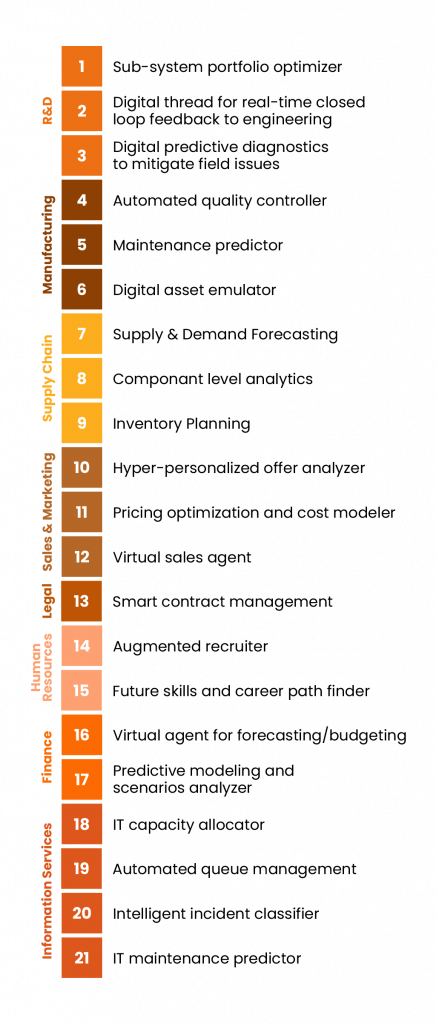
The Result:
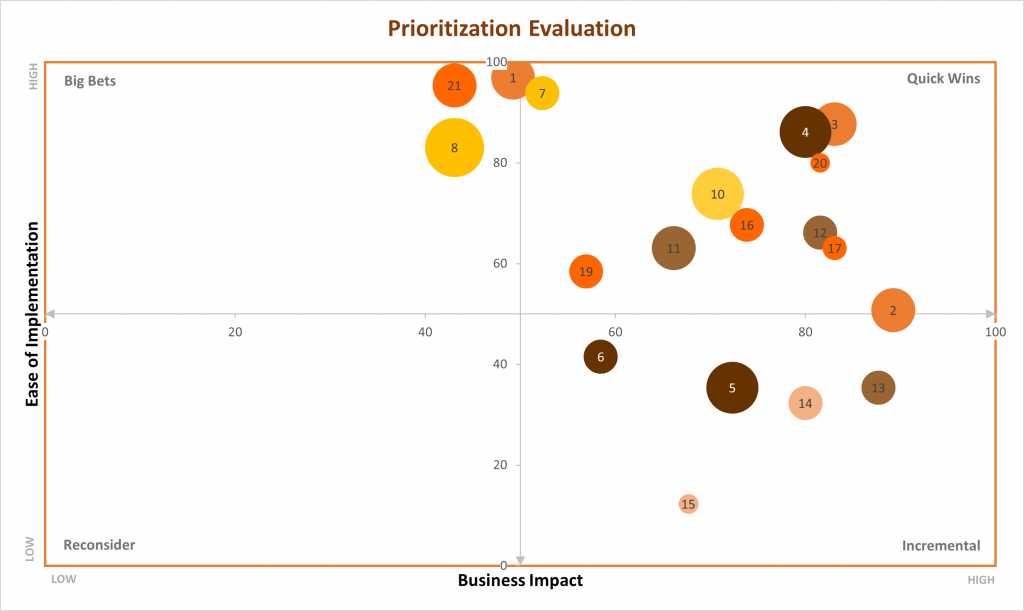
Staying Focused:
From this you can see that 1, 7 & 21 are Big Bets, 4, 10 & 12 are Quick Wins and 5, 13 & 14 are incremental. The objective is then to manage these projects accordingly and from this, you have a prioritized portfolio approach.
Conclusion:
In order to properly benefit from emerging technologies, future-focused companies are doing more than just choosing projects out of thin air. They’re specifically evaluating and prioritizing them with strategic company objectives. If you are interested in the research I did at the Gallagher group, please follow this link for a copy of my research poster presented to the University of Waikato.